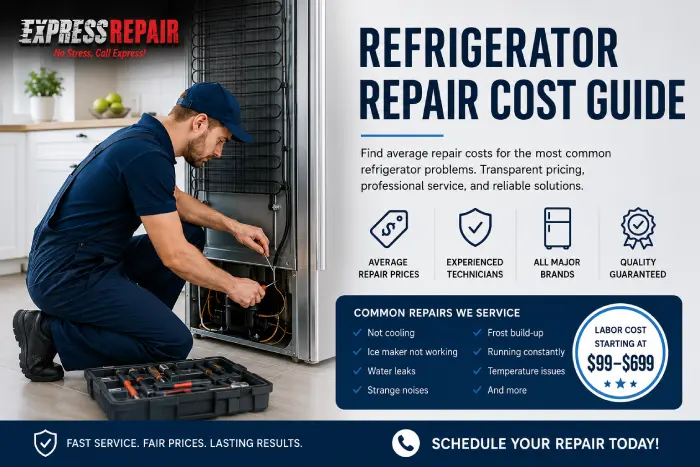
A refrigerator is one of the most important appliances in your home. Since it operates around the clock, even a minor malfunction can quickly lead to spoiled food, water leaks, or rising energy bills.
The cost of refrigerator repair depends on the failed component, the complexity of the repair, and the time required to complete the work. Below are some of the most common refrigerator repairs, their average labor costs, and the main factors that affect refrigerator repair costs.
If your refrigerator is developing excessive frost buildup or experiencing inconsistent temperatures, a faulty defrost thermostat may be the cause.
The defrost thermostat monitors evaporator temperatures and helps regulate the automatic defrost cycle. When it fails, ice can accumulate on the coils and restrict airflow throughout the refrigerator. Similar symptoms may also point to a defrost heater assembly issue.
Average Labor Cost: $179–$249
A failed defrost heater can cause heavy frost accumulation on the evaporator coils, reducing airflow and cooling performance.
Homeowners often notice a warm refrigerator compartment while the freezer remains partially operational. Replacing the heater restores proper defrost function and airflow.
Average Labor Cost: $199–$249
If your refrigerator is running constantly, making unusual noises, or struggling to stay cool, the condenser fan motor may need replacement.
This component removes heat from the condenser coils and helps the refrigeration system operate efficiently. Loud operation may also be related to leveling or vibration problems.
Average Labor Cost: $199–$249
The evaporator fan circulates cold air throughout the refrigerator and freezer compartments.
When the fan motor fails, you may notice that the freezer remains cold while the fresh food section becomes warm. Replacing the fan motor restores proper airflow and temperature balance.
Average Labor Cost: $199–$249
A refrigerator that clicks repeatedly but fails to start may have a defective start relay or capacitor.
These components help the compressor start and operate properly. Failure can prevent the refrigerator from cooling altogether.
Average Labor Cost: $179–$249
The electronic control board serves as the central control system for modern refrigerators.
A failed control board can cause erratic cooling, display errors, fan malfunctions, or complete system shutdown. Replacement is often necessary when electronic components stop responding correctly.
Average Labor Cost: $199–$249
If your refrigerator is leaking water or your ice maker has stopped producing ice, the water inlet valve may be malfunctioning.
The valve controls the flow of water to both the ice maker and water dispenser systems. If the ice maker itself has failed, see ice maker assembly replacement cost.
Average Labor Cost: $179–$249
Ice makers contain several moving components that can wear out over time.
Common signs of failure include no ice production, slow ice production, leaking water, or misshapen ice cubes. Replacing the assembly often resolves these issues.
Average Labor Cost: $199–$249
A damaged door gasket allows cold air to escape and warm air to enter the refrigerator.
This forces the appliance to run longer, increases energy consumption, and can create cooling problems. Replacing the gasket helps maintain proper temperatures and efficiency.
Average Labor Cost: $199–$249
The thermistor is a temperature sensor that communicates with the refrigerator's control board.
When the sensor provides inaccurate readings, the refrigerator may run too long, not cool enough, or freeze food unexpectedly. Temperature problems can also be related to the damper control assembly.
Average Labor Cost: $99–$199
Water collecting underneath crisper drawers or leaking onto the floor is often caused by a clogged drain tube.
Clearing the blockage allows condensation and defrost water to drain properly, preventing future leaks.
Average Labor Cost: $99–$199
The damper control assembly regulates airflow between the freezer and refrigerator compartments.
A faulty damper may cause uneven temperatures, leaving one section too warm or too cold.
Average Labor Cost: $199–$249
Cracked or damaged filter housings can lead to leaks, poor water flow, and dispenser problems.
Replacing the housing restores proper operation and helps prevent water damage. Water delivery issues may also require water dispenser switch repair.
Average Labor Cost: $179–$249
Sealed system problems are among the most complex refrigerator repairs.
Symptoms often include poor cooling, long run times, frost pattern issues, and rising temperatures in both compartments. Specialized equipment and certified procedures are required for these repairs.
Average Labor Cost: $499–$699
If pressing the dispenser paddle does not release water, a failed actuator or switch may be responsible.
This repair restores proper dispenser functionality and ensures reliable water delivery.
Average Labor Cost: $99–$199
Modern refrigerators use LED lighting systems controlled by dedicated circuit boards.
When the lights flicker, dim, or stop working completely, replacing the LED board is often the most effective solution.
Average Labor Cost: $99–$199
Worn hinges or door cams can make refrigerator doors difficult to open or close.
Over time, this can affect door alignment and compromise the seal, reducing cooling efficiency. A compromised seal may also require door gasket replacement.
Average Labor Cost: $179–$249
Damaged drawer tracks can cause crisper drawers to stick, sag, or become difficult to operate.
Repairing the track system restores smooth drawer movement and prevents additional damage.
Average Labor Cost: $99–$199
Excessive vibration, rattling noises, or uneven operation may indicate leveling issues.
Adjusting the refrigerator's leveling system can eliminate noise, improve door alignment, and help the appliance operate more efficiently.
Average Labor Cost: $99–$199
Several factors can influence the final cost of refrigerator repair. While some repairs require only minor adjustments or component replacements, others involve complex diagnostics and specialized parts.
Simple repairs such as drain tube clearing or thermistor replacement generally cost less than major repairs involving sealed system components or electronic controls.
Different refrigerator brands use different parts and technologies. Premium and built-in models often require specialized components and additional labor.
Some replacement parts are readily available, while others may need to be special ordered from the manufacturer. Availability can affect both repair costs and scheduling.
Older refrigerators may require additional troubleshooting and can sometimes involve discontinued parts, making repairs more complex.
Addressing a small issue early can often prevent a much larger and more expensive repair later. Strange noises, water leaks, and cooling issues should be diagnosed as soon as possible.
Refrigerators can develop a variety of issues over time. Recognizing the warning signs early can help prevent expensive repairs and reduce the risk of food spoilage.
One of the most common refrigerator problems is inadequate cooling. This issue may be caused by a faulty evaporator fan motor, condenser fan motor, thermistor, or control board.
If your refrigerator is not maintaining proper temperatures, professional diagnosis is recommended as soon as possible.
A freezer that struggles to keep food frozen may indicate problems with the defrost system, evaporator fan motor, or sealed refrigeration system.
Ignoring the problem can lead to spoiled food and additional stress on the compressor.
Water leaks are often caused by a clogged drain tube, damaged water inlet valve, cracked water filter housing, or ice maker issues.
Prompt repairs can help prevent flooring damage and mold growth.
If your refrigerator has stopped producing ice, the problem may be related to the ice maker assembly, water inlet valve, or dispenser components.
Many ice maker issues can be repaired quickly before they lead to larger system failures.
Buzzing, rattling, clicking, or grinding sounds may indicate problems with fan motors, compressor start components, or leveling issues.
Unusual noises should never be ignored, as they often signal developing mechanical problems.
A refrigerator that rarely shuts off may be experiencing airflow restrictions, thermostat issues, door seal failures, or control board malfunctions.
Continuous operation can increase energy consumption and shorten the lifespan of the appliance.
 Request Service
 (647) 492-7773
