If your refrigerator is building up frost, the freezer is “snowy,” or the fresh-food section is getting warm, there’s a good chance the automatic defrost system isn’t doing its job. Modern fridges don’t rely on you to manually defrost them—most models run a defrost cycle several times a day to melt ice off the evaporator coil and keep air moving properly.Below is a people-first guide to
why a refrigerator stops defrosting, what you’ll typically notice, and what you can safely check—without turning this into a “how to manually defrost” tutorial (that’s a separate topic).
Table of Contents
How auto-defrost is supposed to work
Inside the freezer, the
evaporator coil gets very cold and naturally attracts moisture from the air. Over time, that moisture freezes into frost. To prevent a thick ice blanket from forming, the fridge periodically runs an
automatic defrost cycle, which typically involves:
- A defrost heater that warms the evaporator coil to melt frost
- A defrost sensor/thermostat (or thermistor) that tells the system when to start/stop heating
- A control (either a defrost timer or the main electronic board) that schedules defrost cycles
- An evaporator fan that circulates cold air after the coil is clear
When any one of these fails—or airflow/humidity issues overwhelm the system—ice builds up, airflow drops, and temperatures become unstable.
Common signs your refrigerator isn’t defrosting properly
You might notice one or more of these:
- Frost or solid ice on the back panel inside the freezer
- Freezer temperature swings (too warm, then too cold)
- Fresh-food section warming up even though the freezer still “kind of works”
- Weak airflow from vents (especially in the fridge section)
- Noisy fan sounds, or a fan that stops because it’s hitting ice
- Ice buildup around the evaporator area (behind the freezer panel)
Tip: A little frost is normal.
Heavy frost or a solid ice sheet is not.
What causes a refrigerator to stop defrosting?
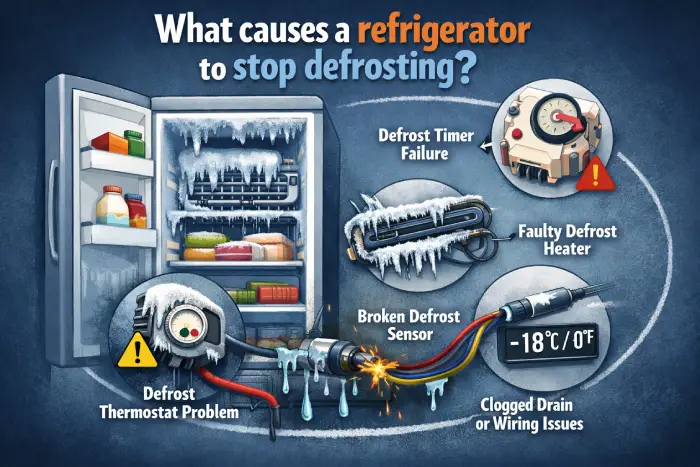
1) Failed defrost heater
The
defrost heater melts frost from the evaporator coil. If it burns out or breaks, the coil stays iced over.
Typical clues:
- Thick frost returns quickly after temporarily melting
- Freezer back panel is heavily frosted
- Airflow gets worse over days/weeks
What this often leads to: freezer may still feel cold, but the fridge section warms because air can’t circulate through an iced coil.
2) Bad defrost thermostat or defrost sensor (thermistor)
Depending on the model, the fridge uses a
defrost thermostat (bi-metal) or a
thermistor to monitor temperature and regulate the defrost cycle. If it fails, the system may never enter defrost—or may stop too early.
Typical clues:
- Frost gradually builds and never fully clears
- Defrost cycle seems inconsistent
- Some models may show error codes related to defrost or temperature sensing
3) Defrost timer stuck (older models)
Older refrigerators often use a
mechanical defrost timer. If it gets stuck, the fridge may never switch into defrost mode.
Typical clues:
- Gradual frost buildup over time
- The unit runs and runs but never “catches up”
- No obvious sensor error codes (because it’s mostly mechanical)
4) Control board problem (newer models)
Newer refrigerators use an electronic
control board to manage defrost frequency and duration. Power surges, moisture, or component failure can cause missed defrost cycles.
Typical clues:
- Random or intermittent symptoms
- Defrost issues plus other odd behavior (lights, fans, or temperature control acting strangely)
- Error codes on display models
5) Evaporator fan not running (or blocked by ice)
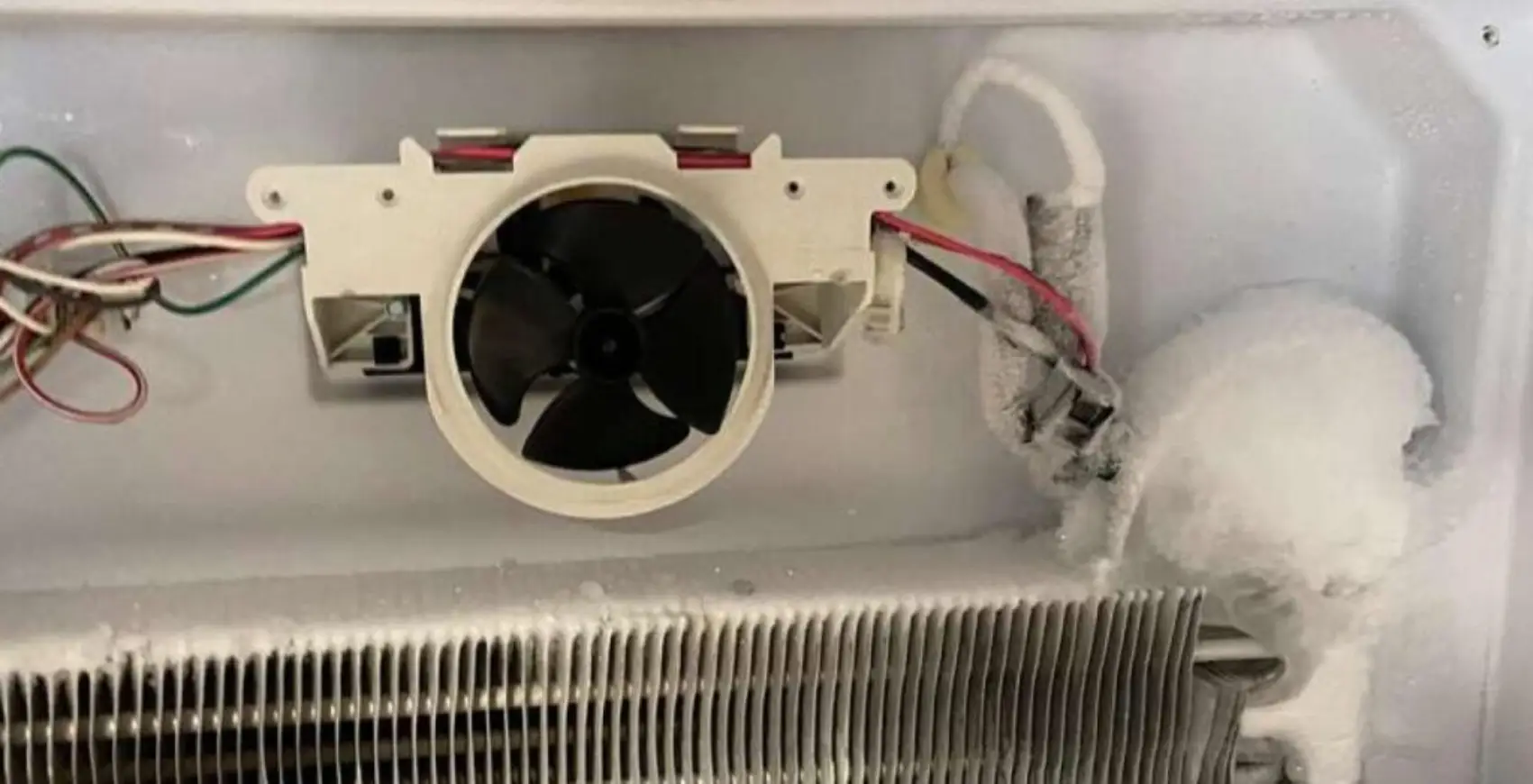
Even if the fridge cools, it still needs the
evaporator fan to move cold air from the freezer to the fridge section. If the fan fails—or gets jammed by ice—temperatures won’t stabilize.
Typical clues:
- Fridge section warm, freezer somewhat cold
- Weak airflow from vents
- Fan noise changes, squeals, or stops entirely
6) Door gasket leak or frequent warm-air intrusion
A torn or warped
door gasket, a door that doesn’t close fully, or frequent opening can bring in humid air. That creates excess frost faster than the defrost cycle can handle.
Typical clues:
- Frost concentrated near the door or on one side
- Condensation around the gasket
- The door pops open slightly or doesn’t “grab” shut
This isn’t always the only problem—but it can make a small defrost issue become a big one.
7) Incorrect temperature settings or overloaded airflow
If vents are blocked by packed food, airflow suffers and frost can build unevenly. Extremely cold settings can also increase frost risk in certain conditions.
Typical clues:
- Frost forms in specific corners
- Some areas freeze solid while others are warm
- Items block vents or are pressed against the back panel
8) Defrost drain issues (related—but a different problem)
A refrigerator’s defrost cycle melts frost into water that should flow out through a
defrost drain. When that drain is clogged, you’ll often see water pooling, refreezing, or ice forming in places it shouldn’t.
Important: Drain problems can
look like “not defrosting,” but they’re usually
a drainage/ice management issue rather than the heater/sensor/control failing.
If your main symptom is
water pooling, ice on the freezer floor, or recurring clogs, that’s best handled as a dedicated drain issue (not as the core “no defrost” diagnosis).
What you can safely check before calling a technician
You don’t need to disassemble anything to do these basics:
- Check the door seal: Look for gaps, tears, or areas that don’t press evenly.
- Confirm the door closes fully: Leveling issues or overstuffed shelves can prevent a tight close.
- Clear vents: Make sure food isn’t blocking the freezer vents or the fridge air returns.
- Look for heavy frost patterns: Frost on the freezer back panel is a strong indicator of an evaporator/defrost issue.
- Listen for the evaporator fan: With the door switch pressed (on many models), you should hear airflow/fan activity.
Avoid: chipping ice with sharp tools or forcing panels off. If you suspect a defrost-system failure, continued operation can worsen ice buildup and cooling performance.
When you need help with your fridge, our
trained and experienced fridge repair technicians can solve your issues for you as soon as possible.



 Request Service
 (647) 492-7773

